
Home Demolition in St. Petersburg, FL
Home demolition takes a house down to the pad, and it is a permitted job – utility disconnects, county approval and a site survey come before any machine moves. A single-family teardown commonly produces around 35 cubic yards of debris, which is why it runs on 20 and 30 yard roll-offs staged on site rather than truck loads, and the truck needs about 50 feet of straight clearance to place them. Pricing runs $50 a cubic yard with a $150 floor, written down and agreed before work starts rather than tallied up afterward.
SERVING MOST LOCATIONS IN
- St. Petersburg
- Clearwater
- Tampa
- Pinellas County
- St. Petersburg
- Clearwater
- Tampa
- Pinellas County
Reliable Home Demolition Near You
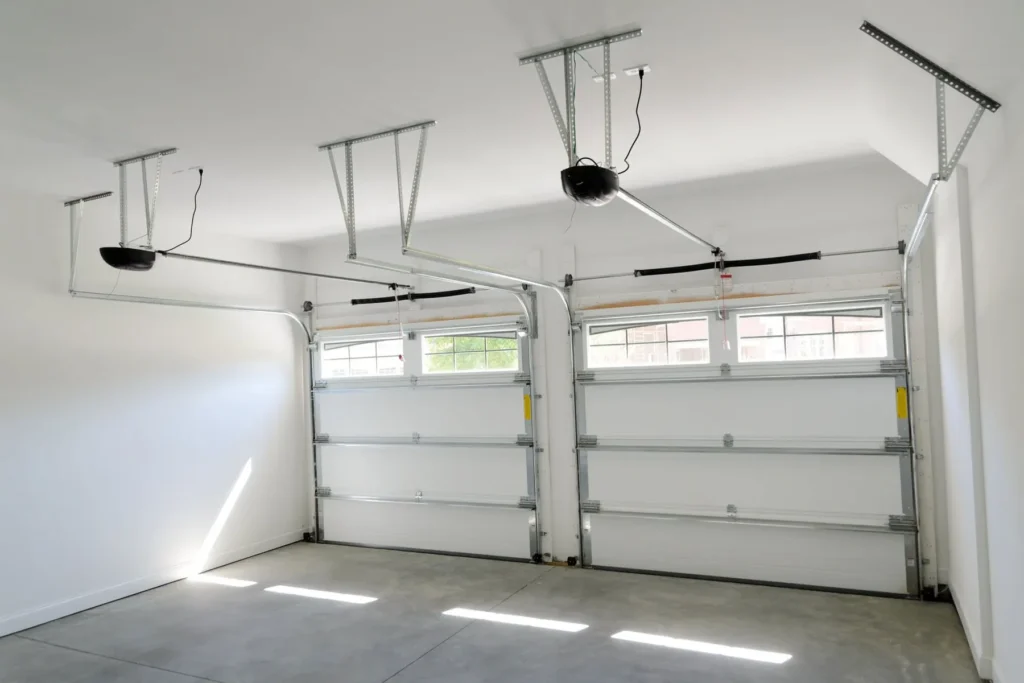
Elephants Dumpster Rental & Junk Removal delivers premier home demolition services with a focus on safety and efficiency. From removing outdated decks to renovating entire homes or even complete structure demolitions, our skilled team is ready to tackle your project. We provide comprehensive demolition solutions, preparing your property for its next stage, whether it’s new construction or a landscaping overhaul.
How Our Home Demolition Works
Our team handles each home demolition project with expertise and care. Here’s how we ensure a seamless process:
- Site Assessment: We start by evaluating the structure to determine the most effective demolition strategy.
- Transparent Quoting: You receive a clear, upfront quote before any work begins, ensuring there are no surprises.
- Safe Demolition: Our experienced team dismantles the structure with strict adherence to safety protocols and regulations.
- Debris Removal: After demolition, we efficiently clear away all debris, leaving the site clean and ready for its next phase.
Comprehensive Home Demolition Services
- Deck and Patio Removal: We expertly dismantle and remove old or damaged decks and patios, clearing the way for new outdoor living areas.
- Structural Demolition: Whether it’s small outbuildings or entire homes, we manage a range of structural demolition projects with precision.
- Renovation Prep: Getting ready for a renovation? We handle the removal of interior walls, flooring, and other elements to prepare your space.
- Additional Services: Our offerings extend to fence removal, yard debris cleanup, and more, supporting all your renovation and landscaping needs.
Effortless Scheduling for Demolition Services
Affordable Home Demolition Solutions
Transparent Pricing: We base our rates on the specifics of your project, ensuring cost-effective options with no hidden charges.
Instant Quotes: Obtain a detailed quote after our initial assessment to understand the costs upfront.
No Hidden Costs: The quote we provide is the final amount you pay, guaranteeing clear and honest billing.
Flexible Payment Methods: Choose from various payment options, including cash, credit cards, and checks, for your convenience.
Booking your demolition service is straightforward:
Online Scheduling: Easily book through our website by selecting your desired date and time.
Phone Scheduling: For personalized assistance, call us at 727 240 7033
Your Trusted Partner in Home Demolition
Elephants Dumpster Rental & Junk Removal is dedicated to providing dependable, efficient, and safe home demolition services. Whether you’re preparing for a new deck, garden, or hot tub, or tackling a comprehensive home renovation, we ensure a smooth and hassle-free demolition experience. Reach out to us today to schedule your service or request a cost estimate, and leave the rest to us.
Same-Day and Next-Day Appointments: Need prompt demolition services? We offer quick scheduling options to address your urgent needs.

Our Main Service Areas
- St. Petersburg
- Clearwater
- Tampa
- Largo
- Seminole
- Pinellas Park
- Tarpon Springs
- Palm Harbor
- Dunedin
- Redington Beach
- Clearwater Beach
- St. Pete Beach
What Home Demolition Actually Includes
Home demolition covers a wide range of work, and the right approach depends entirely on what you are trying to accomplish. Some projects call for a full structural teardown, where the house comes down to the slab and the lot is cleared for new construction. Others only need selective interior demolition so a remodel can move forward without ever touching the roof, exterior walls or foundation.
On a typical residential job in Pinellas County, the work breaks into four stages: site preparation and protection, utility disconnection and verification, the demolition itself, and debris removal and site cleanup. Rushing or skipping any one of those stages is where residential projects go sideways, get red-tagged by an inspector, or turn into something far more expensive than the homeowner budgeted for.
Residential demolition projects we take on
- Interior gut-outs ahead of a remodel — see interior demolition
- Kitchen and bathroom tear-outs — kitchen demolition and bathroom demolition
- Drywall, plaster and ceiling removal — drywall demolition
- Attached and detached garages — garage demolition
- Decks, porches, patios and pergolas — deck demolition
- Sheds and backyard outbuildings — shed removal
- Concrete slabs, walkways and driveways — concrete removal
- Mobile and manufactured homes — mobile home demolition
- Smaller-scope work that does not need heavy equipment — light demolition
- Salvage-first projects where materials are recovered rather than crushed — deconstruction
Full Teardown or Interior Demolition? How to Tell Which You Need
Homeowners often call asking for a “demo” when what they actually need is a fraction of the work they were imagining. The distinction matters because it changes your permit path, your timeline and your cost by an order of magnitude.
A full structural teardown usually makes sense when
- The foundation or slab has failed, or the structure has settled unevenly beyond repair.
- Flood or storm damage has compromised framing, and remediation would cost more than rebuilding.
- The lot is worth substantially more cleared and ready for new construction than it is with the existing house on it.
- You are consolidating lots, changing the footprint, or the existing structure is non-conforming under current code.
- A building official has declared the structure unsafe or unfit for occupancy.
Interior demolition is the better call when
- The shell, roof and foundation are sound and you are reconfiguring what is inside.
- You need cabinets, flooring, tile, drywall, fixtures and non-load-bearing partitions taken out cleanly so trades can start.
- You want to keep the existing permit history and footprint intact rather than starting over.
- Only part of the home is affected — one bathroom, a kitchen, a converted garage.
If you are not sure which side of that line your project falls on, that is worth a phone call before you commit to anything. Getting the scope right on day one is the cheapest decision you will make on the entire project.
Florida Demolition Rules Every Homeowner Should Know Before Work Starts
Residential demolition in Florida is governed at three levels at the same time: state contractor licensing law, federal air-quality rules that are enforced locally, and your city or county building department. Most of the horror stories homeowners tell start with one of these being discovered halfway through the job instead of before it.
1. Taking down a house is licensed contracting work in Florida
Under Florida Statutes section 489.105(3), the term “demolish” is defined for the purposes of contractor regulation as demolition of steel tanks more than 50 feet in height, towers more than 50 feet in height, other structures more than 50 feet in height, and all buildings or residences. That last phrase is the one that matters to you: there is no square-footage or height threshold that lets a house slip outside the statute. Florida also splits contractors into Division I and Division II categories, and structural demolition sits with Division I scopes. Before anyone puts equipment on your property, verify the license and its scope through the Florida Department of Business and Professional Regulation.
2. You need a demolition permit — and probably from your city, not the county
Pinellas County requires a permit for any new building, addition, remodeling or demolition, and for work exceeding $500. But if your property sits inside an incorporated municipality — St. Petersburg, Clearwater, Largo, Pinellas Park, Seminole, Dunedin, Safety Harbor and the rest — the demolition permit comes from that city’s building department, not from the county. The county handles unincorporated Pinellas. Historic district review, coastal construction control line setbacks and flood zone requirements can each add review time on top, which is why the permit conversation should start weeks before you want equipment on site.
3. Utility locates are legally required at least two full business days ahead
Florida’s Underground Facility Damage Prevention and Safety Act requires notice through the state’s one-call system before excavation or demolition. Florida Statutes section 556.105(1)(a) states that not less than 2 full business days before beginning any excavation or demolition that is not beneath the waters of the state — and not less than 10 full business days for work beneath state waters — the excavator must submit the project details through the system, including the county, the closest street or intersection, the construction limits, and the commencement date. The locate request costs nothing. Hitting an unmarked gas, water, sewer, fiber or electrical line costs a great deal, and liability follows whoever failed to call.
4. Utilities have to be disconnected, not just shut off
Power, gas, water and sewer all need to be formally disconnected and capped by the utility or a licensed trade before a structure comes down, and most building departments want that documented before they will release the permit or pass inspection. In Pinellas County, sewer service also has to be properly cut and capped, and you have to notify the utility afterward or you will keep getting billed for sewer service on a house that no longer exists.
The Asbestos Notification Rule That Catches Most Pinellas Homeowners Off Guard
If there is one requirement that derails residential demolition schedules in Pinellas County, it is this one. It applies more broadly than people assume, and the notification window is long enough that discovering it late will cost you weeks.
The federal rule is the Asbestos NESHAP — the National Emission Standards for Hazardous Air Pollutants for asbestos — codified at 40 CFR Part 61, Subpart M. It was first promulgated in 1973 and most comprehensively amended in 1990. In Pinellas County it is enforced by the Pinellas County Air Quality Division, and the county’s published requirements are unusually specific:
- Every demolition requires a notification, submitted at least 10 working days — two calendar weeks — before demolition begins, and that is true even when no asbestos is found.
- You must first obtain a written asbestos survey report from a state-licensed asbestos consultant, and that survey has to be submitted together with the demolition notice.
- If asbestos is present, it has to be removed before demolition or renovation begins.
- For renovation work, notification is triggered once regulated asbestos-containing material reaches 160 square feet on facility components, 260 linear feet on pipes, or 35 cubic feet where the amount cannot otherwise be measured.
- Where a building official has declared a structure structurally unsound and in danger of imminent collapse, the window shortens to one day before demolition.
- The 10-working-day clock does not start until the notification, the fees and the survey documents have all been submitted.
- Critically: a building permit or advisory statement from the local building department does not satisfy the notification requirement. The notification has to go directly to Pinellas County Air Quality.
Is a single-family home exempt?
Sometimes, and only partly. Under certain conditions a single-family residential home, or an apartment building with four or fewer dwelling units, may be exempt from specific asbestos requirements. The exemption does not apply when the dwelling is part of a larger project — the EPA has been explicit that houses demolished as part of an urban renewal effort, a road project, or a commercial development are not exempt. Pinellas County publishes an eligibility checklist and asks that you confirm your project qualifies by contacting its Air Quality Division at (727) 464-4422 or asbestos@pinellas.gov rather than assuming.
Who is responsible for filing?
The county casts a wide net here. Responsibility falls on any person who owns, leases, operates, controls or supervises the facility being demolished, or who owns, leases, operates, controls or supervises the demolition operation — or both. That list expressly includes owners, consultants, contractors and subcontractors. In other words, “I assumed my contractor filed it” is not a defense that removes the homeowner from the picture.
Handling and disposal
All removal and handling of asbestos-containing material must be performed by a Florida-licensed asbestos contractor, with trained and certified personnel, in compliance with OSHA requirements. The waste itself has to be adequately wetted, sealed in leak-tight labeled containers, and disposed of at a landfill permitted to receive asbestos waste, with shipment records kept. Vehicles transporting it carry their own labeling and recordkeeping obligations.
The regulatory information on this page is general guidance compiled from published EPA and Pinellas County sources and is not legal advice. Rules change, and requirements differ between municipalities. Confirm what applies to your specific address with your local building department and with Pinellas County Air Quality before any work begins.
What Happens to the Debris After the Structure Comes Down
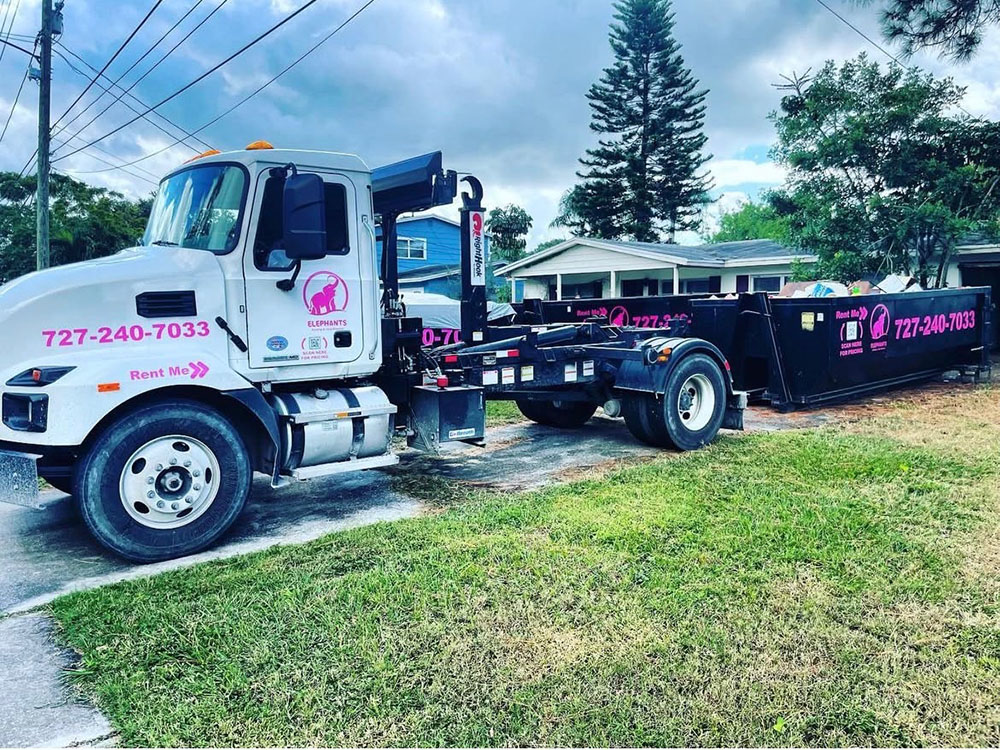
Demolition generates far more volume than almost anyone expects. A modest kitchen tear-out fills a container. A whole-house teardown produces mixed construction and demolition debris — framing lumber, drywall, roofing shingles, concrete, tile, insulation, ductwork, cabinetry, plumbing fixtures, windows and scrap metal — and how that material is separated has a direct effect on both your disposal cost and how much of it stays out of the landfill.
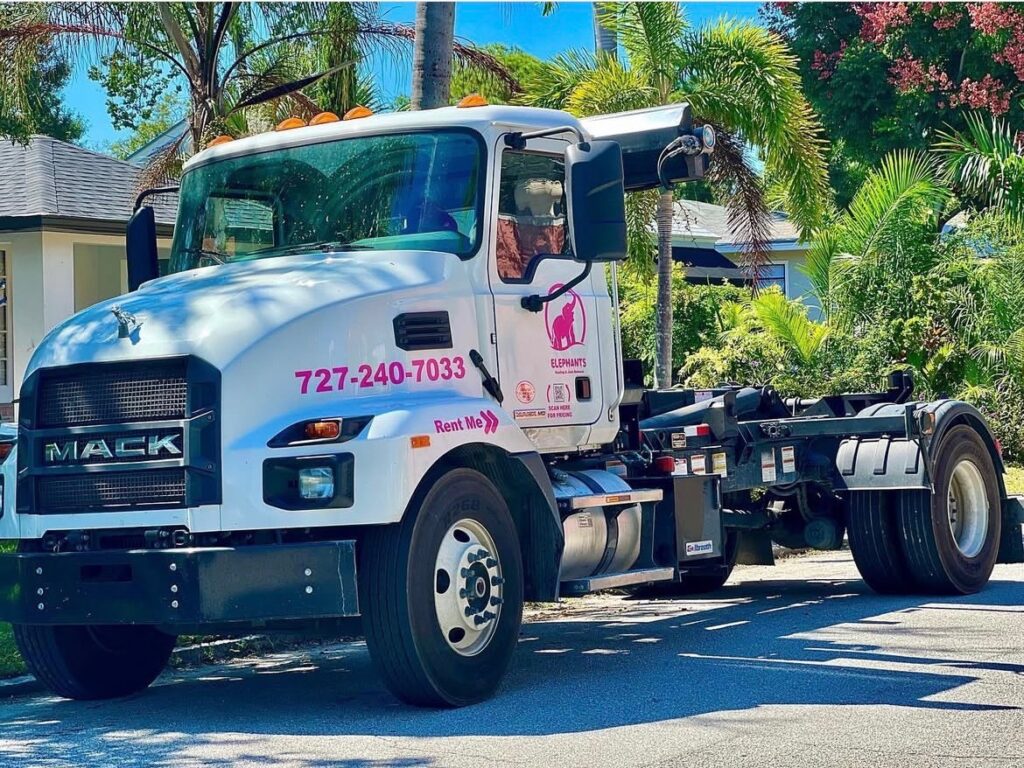
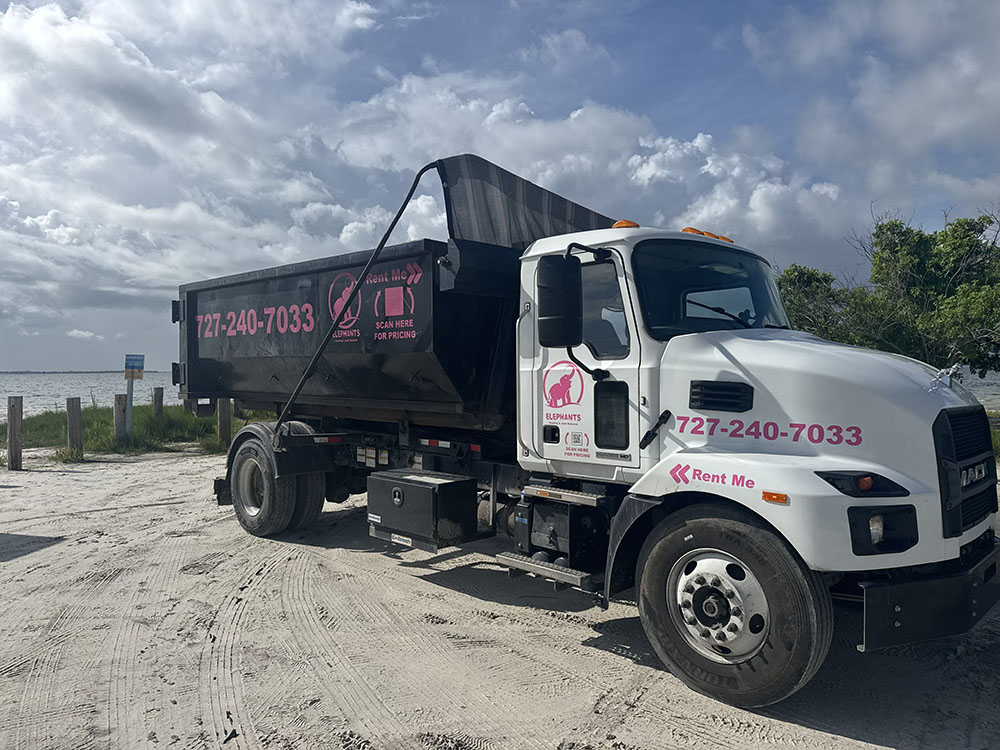
This is the half of the job most demolition conversations underrate, and it is the part we do every single day. We can stage roll-off dumpsters on site so debris never piles up in the yard, swap containers as they fill, and haul the last load out so the lot is left clean rather than merely flattened.
Matching container size to the job
- 10 yard — single-room interior tear-outs and dense, heavy material like tile, plaster and concrete, where weight fills the container long before volume does.
- 15 yard — a kitchen or a couple of bathrooms, small deck removals, garage clear-outs.
- 20 yard — the workhorse size for whole-floor interior demolition and mid-size structures.
- 30 yard — full teardowns and bulky, lightweight debris such as framing, roofing and siding.
Contractors running multiple trades on a site usually want a standing container rather than one-off pickups — that is what contractor and commercial dumpster rental is for. Homeowners doing the work themselves are generally better served by residential dumpster rental.
Related hauling we handle alongside demolition: construction debris removal, concrete removal, yard debris removal, and full-scope commercial junk removal for property managers and contractors.
How to Prepare Your Property for Demolition Day
A little preparation removes most of the friction from a demolition day. Before the crew arrives:
- Pull anything you intend to keep. Appliances, light fixtures, hardware, built-ins, heirloom materials. Once demolition starts, it is all debris.
- Confirm the permit is issued and posted, and that your asbestos notification window has fully elapsed.
- Verify utilities are disconnected and capped, with documentation on hand for the inspector.
- Make sure the locate marks are fresh. Paint and flags have a limited life; if the job slips, the request may need to be renewed.
- Clear access for equipment and containers. Note gate widths, low branches, soft ground, irrigation lines and septic components.
- Identify what must be protected — a shared fence, a neighbor’s driveway, mature trees, an AC condenser, a pool deck, a seawall.
- Give the neighbors a heads-up. It costs nothing and prevents most complaint calls.
- Plan for dust and water. Suppression is a compliance issue as much as a courtesy one in Florida.
What Drives the Cost of Home Demolition in Pinellas County
We quote per project rather than from a rate card, because two houses of identical square footage can differ enormously in cost. The variables that move a demolition estimate most:
- Scope — interior-only versus full structural teardown, and whether the slab and foundation come out too.
- Square footage and number of stories, plus how the building is framed.
- Material mix and disposal weight. Concrete, tile and plaster are heavy; disposal is often priced by the ton.
- Asbestos or lead findings, which add survey, abatement and specialised disposal steps.
- Site access. Tight lots, narrow easements, alley-only access and overhead lines all slow equipment down.
- Salvage value, if a deconstruction approach can recover material worth keeping.
- Permit and notification fees, which vary by municipality.
- Protection requirements for adjacent structures, trees and hardscape.
For a general sense of how we structure our work, see our pricing page — but for demolition specifically, a walkthrough or a few photos will get you a far more accurate number than any online calculator.
Demolition After Hurricane or Flood Damage
On the Gulf side of Pinellas County this is not a hypothetical. Storm surge and wind damage regularly leave homeowners with a structure that has to come down rather than be repaired, and the sequence in that situation is different from a planned teardown.
Insurance and adjuster documentation usually has to come first, so photograph everything before anything is moved. If a building official has declared the structure unsafe or in danger of imminent collapse, the asbestos notification window can compress from ten working days to one day — but that determination has to come from the building official, not from you or your contractor. Pinellas County also runs streamlined storm-recovery permitting after major events, which is worth asking about specifically rather than assuming standard timelines apply.
For the cleanup side of storm work, see hurricane debris removal. Waterlogged drywall, insulation and flooring need to come out fast to limit mould growth, which usually means interior demolition before any rebuild can be scheduled.
A Realistic Timeline for a Residential Demolition
Homeowners routinely expect demolition to take a day. The physical work often does. The schedule around it is what takes time, and the asbestos notification is the long pole:
- Week 1 — site walkthrough and scope, asbestos survey by a licensed consultant, permit application submitted.
- Week 1–2 — asbestos notification filed with Pinellas County Air Quality, starting the 10-working-day clock. Utility disconnection requests submitted.
- Week 2–3 — permit issued, utilities disconnected and capped, abatement performed if the survey found asbestos.
- Week 3–4 — one-call locate request filed at least 2 full business days ahead, containers staged, demolition performed, debris hauled, site graded and cleaned.
Three to four weeks from first call to a cleared lot is a realistic planning assumption for a permitted structural demolition in Pinellas County. Interior demolition that requires no notification and no structural permit can often move in days rather than weeks.
Where We Provide Home Demolition
We work throughout Pinellas County and across the bay into Tampa, from our base in St. Petersburg. That includes Clearwater, Largo, Seminole, Pinellas Park, Dunedin, Safety Harbor, Palm Harbor, Tarpon Springs, Gulfport, South Pasadena, Treasure Island, Madeira Beach, St. Pete Beach, Tierra Verde, the Belleair communities, the Redington beaches, Indian Rocks Beach, Indian Shores, Oldsmar and Kenneth City.
The full list, with dedicated pages for each community, is on our service area page. A few of the areas we work in most often: Largo, Tampa and St. Petersburg. You can also browse every service under our demolition services hub.
Home Demolition in St. Petersburg, Clearwater and Tampa
The three cities we cover hardest for home demolition are St. Petersburg, Clearwater and Tampa. Between them sits the rest of Pinellas County, and we work those beach towns and inland suburbs constantly.
St. Petersburg, FL
St. Petersburg is our home city and the shortest drive we make, which is why home demolition here is the easiest to fit in on short notice. From Snell Isle and Old Northeast down through Historic Kenwood, Greater Woodlawn, Lakewood Estates and the Skyway Marina District, we already know which streets have rear alley access and which ones need a smaller truck. See the full St. Petersburg service page.
Clearwater, FL
Clearwater work is a daily thing for us. From the condo towers on Sand Key to the single-family blocks around Countryside and On Top of the World, home demolition here is usually about access rules more than volume — HOA approval, service elevators, restricted haul hours. We deal with all of it so you do not have to. Details on our Clearwater coverage.
Tampa, FL
Yes, we cross the bay. Tampa home demolition is booked the same way everything else is, covering Downtown, Water Street, Harbour Island, Bayshore Beautiful, Seminole Heights, Carrollwood, Westchase and Temple Terrace. Because Tampa is in Hillsborough County, bridge time and a different tipping fee are baked into the quote — there is no surprise bridge surcharge added at the end. More on our Tampa junk removal coverage.
The Rest of Pinellas County
The rest of the county is standard route work, not a special trip. Mid-county we cover Largo, Pinellas Park and Seminole. North county is Dunedin, Palm Harbor, Tarpon Springs, Safety Harbor, Oldsmar and East Lake. The barrier islands are St. Pete Beach, Treasure Island, Madeira Beach, Indian Rocks Beach, Indian Shores, Redington Beach, Redington Shores, North Redington Beach, Clearwater Beach and Tierra Verde. We also serve Gulfport, Kenneth City, South Pasadena, Belleair, Belleair Beach, Belleair Bluffs, Belleair Shore, plus Westchase and Gandy across the bay. See the Pinellas County overview for the whole map.
Not sure whether your address is inside the line? Call 727-240-7033 and ask. We would rather tell you honestly that a job is outside our range than take a deposit and cancel on you.
Frequently Asked Questions About Home Demolition in Florida
Do I need a permit to demolish a house in Pinellas County?
Yes. Pinellas County requires a permit for any demolition, as well as for new building, additions, remodeling, and work exceeding $500. If your property is inside an incorporated city such as St. Petersburg, Clearwater or Largo, the permit is issued by that city’s building department. The county handles unincorporated areas.
Do I really need an asbestos survey if my house was built recently?
Pinellas County requires a written asbestos survey from a state-licensed asbestos consultant before the demolition notification is submitted, and the survey has to accompany that notice. All demolitions require notification even when no asbestos is present. Certain single-family homes and buildings with four or fewer dwelling units may qualify for an exemption from specific asbestos requirements, but the county asks you to confirm eligibility with its Air Quality Division at (727) 464-4422 rather than assuming.
How far in advance does the asbestos notification have to be filed?
At least 10 working days — two calendar weeks — before demolition begins. The clock does not start until the notification, the fees and the survey are all submitted. If a building official has declared the structure unsound and in danger of imminent collapse, that window drops to one day.
Does my building permit cover the asbestos notification?
No. Pinellas County states plainly that a permit or advisory statement from the local building department does not meet the notification requirement. The asbestos notification must be submitted directly to Pinellas County Air Quality.
Can I demolish my own house if I own it?
Florida law defines “demolish” for contractor-regulation purposes as including all buildings or residences, along with tanks, towers and other structures over 50 feet in height (Florida Statutes 489.105(3)). Structural demolition is licensed work. Owner-builder provisions exist in Florida but are narrow and carry real liability, so check with your building department before assuming you can self-perform.
How long does the demolition itself take?
The physical teardown of a typical single-family home is often one to three days, with debris hauling and site cleanup following. The surrounding process — survey, permit, notification window, utility disconnection — is what makes three to four weeks a realistic overall timeline.
Do you handle the debris, or do I arrange that separately?
We handle it. Debris hauling is our core business, so we can stage roll-off containers on site, swap them as they fill, and clear the final load. See also construction debris removal.
Can you demolish just part of my house?
Yes, and it is a large share of what we do. Interior demolition, kitchen tear-outs, bathroom tear-outs, drywall removal, garages and decks can all be taken out selectively while the rest of the home stays intact.
What about the concrete slab and driveway?
Those can come out with the structure or be handled as their own project — see concrete removal. Concrete is heavy, so it usually drives container sizing more than volume does.
Do you work outside Pinellas County?
Yes. We regularly cross the bay into Tampa and Hillsborough County. Our full coverage list is on the service area page.
Do you offer home demolition in Tampa, FL?
Yes. Tampa is a regular part of our route, not a special trip. We cross the Howard Frankland, Gandy and Courtney Campbell bridges for home demolition in South Tampa, Hyde Park, Palma Ceia, Seminole Heights, Ybor City, Westchase, Carrollwood, Temple Terrace and New Tampa. Tampa is in Hillsborough County, so loads tip at Hillsborough facilities instead of the Pinellas plant. That difference is already in the number we quote you — there is no bridge surcharge bolted on at the end.
How fast can you get to Clearwater for home demolition?
Clearwater is our second-busiest market, so same-day or next-day is normal. Jobs in Countryside, Skycrest, Morningside and the US-19 corridor are straightforward. Anything on Clearwater Beach, Sand Key or Island Estates we schedule early in the morning, because the Memorial Causeway and beach parking will wreck an afternoon window. If the building needs a certificate of insurance or a reserved service elevator, tell us when you book and we handle it.
Which cities do you serve besides St. Petersburg, Clearwater and Tampa?
All of Pinellas County. Inland that is Largo, Pinellas Park, Seminole, Dunedin, Palm Harbor, Tarpon Springs, Safety Harbor, Oldsmar and East Lake. On the water it is St. Pete Beach, Treasure Island, Madeira Beach, Indian Rocks Beach, Indian Shores, Redington Beach, Redington Shores, North Redington Beach, Clearwater Beach and Tierra Verde. We also cover Gulfport, Kenneth City, South Pasadena, Belleair, Belleair Beach, Belleair Bluffs and Belleair Shore, plus Westchase and the Gandy corridor on the Hillsborough side.
READY WHEN YOU ARE
GET A FLAT PRICE TODAY
Dumpster delivered or junk gone — often the same day. Call or text 727-240-7033, text photos for a price in minutes, or book online in about two minutes. Flat pricing, dump fees included, and a real person on the phone 24/7.