Short answer: photograph everything before you move it, separate vegetative debris from construction debris and household items, keep hazardous material out of the pile, and check whether your city is running free storm debris collection before you pay anyone. Here is the order we tell our own neighbors to work in.
1. Photograph before you touch anything
Insurance adjusters work from evidence. Before a single branch moves, take wide shots of every room and every side of the property, then close-ups of the damaged items. Do this even if you are certain you will not file a claim.
2. Separate the pile into four groups
- Vegetative debris — branches, palm fronds, brush, sod
- Construction and demolition debris — drywall, fencing, roofing, flooring, lumber
- Household goods and furniture — water-damaged couches, mattresses, carpet
- Appliances and electronics — refrigerators, washers, televisions
Municipal storm debris crews normally collect these categories on different passes, and a mixed pile is the single most common reason a pile gets skipped.
3. Keep hazardous material out of the pile
Fuel cans, propane tanks, pool chemicals, paint, car batteries and pesticides do not belong in a storm debris pile or in a dumpster. Take them to the Pinellas County household hazardous waste center at 2855 109th Ave N (Tuesday through Friday and the first and third Saturdays, 7 a.m. to 5 p.m.). Generators and gas cans are especially common after a hurricane — keep them out. Our guide to where junk actually goes in Pinellas County has the full list.
4. Check whether free municipal collection is running
After a major storm, St. Petersburg, Clearwater, Largo and the other Pinellas municipalities usually run a free storm debris collection program for a limited window. If your debris qualifies and you can wait, that is the cheapest option available and we will tell you so. Hire a private hauler when the debris does not qualify, when it is blocking access, or when you are on a contractor or insurance deadline.
After a declared storm the City of St. Petersburg runs its own right-of-way debris collection and it is free. Use it for what it takes. Call us for what it will not: wet drywall coming out of a house, saturated furniture, interior tear-out, garage and attic contents, anything that has to be carried out rather than dragged to the curb.
5. Get it out before the mold clock runs
In Florida humidity, wet drywall, carpet and padding start to become a problem quickly. Getting saturated material out of the building fast is one of the few things a homeowner fully controls. We remove wet drywall, carpet, padding, insulation and furniture. We do not perform mold remediation — that requires a licensed remediation contractor, and we will say so rather than take work we are not licensed for.
What Helene and Milton actually did to St. Petersburg
Every hauler in Tampa Bay says they are there after the storm. Here is what actually happened in 2024, because the details matter and most people get them wrong.
Helene, late September 2024, drove a record surge into the peninsula. The St. Petersburg gauge measured 6.31 feet above normal high tide.
Milton, three weeks later, did not flood St. Pete with surge. Tampa Bay ran backwards — a blowout tide that pulled water nearly five feet below normal. Milton’s damage here was rain, wind and tornadoes, not water coming in off the bay. Albert Whitted Airport recorded 18.87 inches of rain, 5.09 of it in a single hour.
Between the two storms the City of St. Petersburg collected 2.1 million cubic yards of debris, the largest volume in its history. Countywide the figure passed 7.24 million cubic yards.
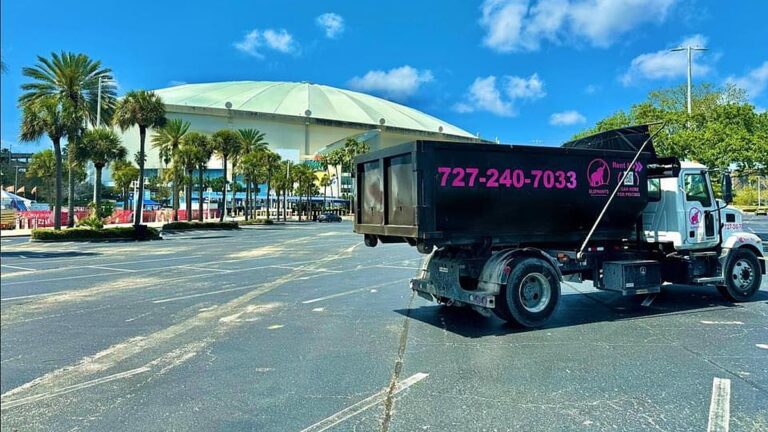
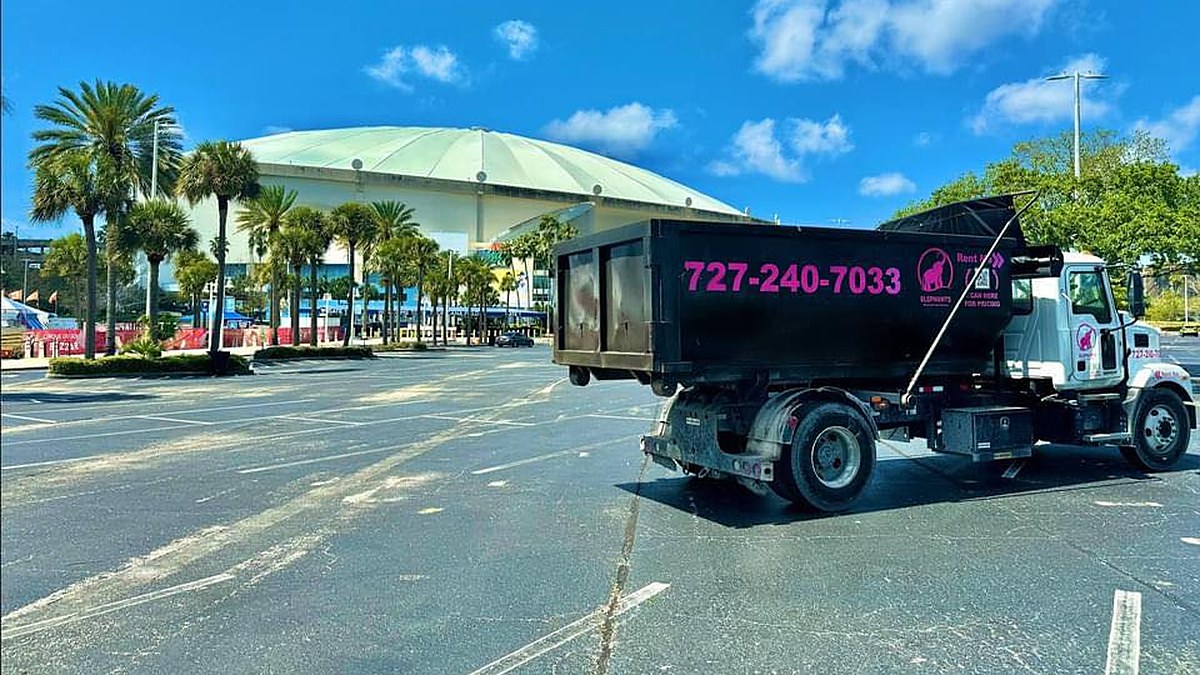
The most visible casualty sat a few blocks west of downtown. Milton stripped the six-acre fabric roof off Tropicana Field on the night of 9 October 2024 — a dome engineered to take 115 mph winds, on a night Albert Whitted clocked gusts to 101. St. Petersburg ultimately approved just under $60 million to put it back. All 24 panels were replaced with a membrane rated to 165 mph, the last one went on in November 2025, and the Rays played the whole 2025 season at Steinbrenner Field in Tampa before coming home in April 2026. We bring it up because it is the clearest picture anyone has of what a Category 3 does to this peninsula, and of how long the cleanup tail runs after the wind stops.
Which St. Petersburg neighborhoods take water first?
The city carries 969 repetitive-loss structures, and 756 of them — 78 percent — sit in the east subarea. Shore Acres and Riviera Bay are both named in the city’s own repetitive loss analysis, and St. Petersburg is spending $33 million on Shore Acres drainage. Shore Acres, Riviera Bay, Venetian Isles and the low spots off Jungle Prada take water first, and we are usually out in them the same week.
Our promise on storm pricing
We do not raise prices after a storm. We did not after Helene or Milton and we will not after the next one. Our post-hurricane rates are our normal rates. Florida law prohibits price gouging during a declared state of emergency, and beyond the law, this is our hometown — owner Joseph O’Donnell was born and raised in St. Petersburg.
Frequently asked questions
Do you charge more after a hurricane?
No. Our post-storm rates are our normal rates. We do not price gouge after a storm, and Florida law prohibits it during a declared state of emergency.
Should I wait for the city to pick up storm debris?
If your debris is ordinary vegetative material and you can wait, municipal storm debris collection is free and is usually the cheapest option. Hire a hauler when the debris is not eligible for city pickup, when it is blocking access, or when you need it gone before an insurance adjuster or contractor arrives.
Can you take flood-damaged drywall, carpet and furniture?
Yes. Water-damaged drywall, insulation, carpet, padding and furniture are standard debris for us. We do not perform mold remediation, and if a property needs a licensed remediation contractor we will tell you rather than take the job.
How fast can you get here after a storm?
We run 24/7 and we prioritize jobs that are blocking driveways, doors and roads. Call or text 727-240-7033 and we will give you a realistic window rather than an optimistic one.
Do I need a dumpster or full-service hauling for storm cleanup?
If your household can carry the debris out over several days, a roll-off dumpster parked on the driveway is cheaper. If the debris is heavy, wet or dangerous, full-service hauling is safer and usually faster.
Need debris gone now?
We are open 24/7 across St. Petersburg, Clearwater, Tampa and Pinellas County. Call or text 727-240-7033, or look at hurricane debris removal, construction debris removal and roll-off dumpster rental.